Ariel Sabar is the author of four nonfiction books, including VERITAS: A Harvard Professor, a Con Man and the Gospel of Jesus’s Wife (Doubleday, 2020) and MY FATHER’S PARADISE: A Son’s Search for his Jewish Past in Kurdish Iraq (Algonquin, 2008). Scroll down to read the reviews and other honors.

Click here for book club resources and to learn more about the Gospel of Jesus's Wife
"Mesmerizing....[Sabar] has our attention, and slowly, remorselessly, he pays out the rest of his devilish yarn...Savor the denouement—and don't leave at intermission."
— Wall Street Journal
"[A] madcap, unforgettable book...for enthusiasts of ancient Christianity...and readers of idea-driven capers, whether by Daniel Silva or Janet Malcolm. It’s a barely believable tale, crazier than a tweed-sniffer in the faculty lounge."
— New York Times Book Review
"Fascinating...engrossing...The interaction of [the con man and the Harvard professor], one with a deep need to deceive and the other with a desperate need to believe, presents a wholly human story of frailty and weakness."
—NPR
"Extraordinary....astonishing...The book is as good as a detective novel, possessing plot, subplots, hidden motives, bees in eccentric bonnets and startling revelations."
— Minneapolis Star Tribune
“A tour de force of investigative journalism.”
— Pittsburgh Post-Gazette
"It’s a story about journalism done right, about Sabar’s own capable, dogged sleuthing to get to the bottom of those famous headlines...Veritas offers a vital lesson less about Christianity than about what happens when a scholar decides that the story is more important than the truth."
— Time Magazine
"A thriller for eggheads"
— Boston Globe
"The fascinating full story..Sabar painstakingly unspools the threads."
— CNN
"A testament to the value of investigative journalism…full of shocking and revelatory moments.”
— Daily Beast
"Book-length expansions of articles often seem bloated, but this one is a remarkable exception. Every page of its icily forensic narrative advances the story in some unexpected way, continually modifying one’s understanding of its principal players and their complex motives. It is partly a psychological thriller about the danse macabre that goes on between a skilled con man and a well-chosen mark, partly a global-historical blockbuster with variants on the obligatory tropes: lurid sex, wicked priests, Egyptology, Nazis. But it is also, most interestingly, a sustained study of the clash between the idea of historical truth as a set of objective facts waiting to be uncovered by rigorous inquiry and the more contemporary notion of it as a construct, amenable to (and fair game for) deliberate intervention. Sabar is clearly in favour of establishing the historical truth, and the spectacular results of his old-fashioned diligence stand as a 400-page rebuke to those who aren’t. But a surprising magnanimity prevails, with both King and her manipulator retaining a measure of sympathy, even respect, to the end.”
— London Review of Books
“This astonishing book—part detective story, part exercise in reporting conducted at its highest level—reaches hold of you by the shirt collar and doesn’t let go. Here is a gallery of types that have surrounded Christianity since its earliest beginnings: the professionally cynical, the frankly mercenary, and the profoundly faithful. It is a tale that takes us from the offices of two Harvard presidents to, perhaps inevitably, that of a Florida pornographer. Exciting on every level, it poses the deepest question of faith: does it depend on the scholarly verification of ancient fragments or on what Heaney called a journey ‘into the marvelous?’ I was bowled over by it.”
— Caitlin Flanagan, author of Girl Land
“Journalistic investigations into ancient artifacts and manuscripts hold a threefold challenge. The first is summoning the stubbornness and patience necessary to track down leads and win the confidence of sources…The second is to access the deeper meaning of the artifact in question and its path through the world, beyond the superficial details. The third is to combine all of this into an absorbing narrative. It’s rare to succeed on all three counts, but Sabar has: Veritas is a masterpiece.”
— Jewish Review of Books
“Thoroughly absorbing...Sabar does an exemplary job of not only digging into every facet, and then some, of the story of Fritz and the long con he pulled on King and Harvard, but in digesting it all and synthesizing it into a comprehensible and exciting narrative. It’s a wild and educational ride. Along the way, readers learn about early Christian history, the vagaries of Coptic script and grammar, the place of papyrus in written communication, methods of dating antiquities, the psychology of the con artist and a great deal more...Sabar turns a complex, esoteric story into a page turner, and reaffirms the adage that truth is stranger than fiction”
— Christian Science Monitor
“Ariel Sabar is an excellent investigative journalist explaining in detail a con that could have changed all of Christianity. Whatever the scam, the con artist and the victim both have an agenda.”
— Frank Abagnale, author of Catch Me If You Can
“The National Book Critics Circle Award-winning author of My Father's Paradise transforms top-notch research skills into riveting suspense…an extraordinary and mind-bending adventure into ancient traditions with modern consequences.”
— Shelf Awareness
"An eminent Harvard scholar. A fragment of ancient papyrus that could upend Christianity. The artifact’s mysterious owner. A web of secrets and intrigue. Those details might remind you of Dan Brown’s monster 2003 bestseller The Da Vinci Code. But Ariel Sabar’s new book, while just as wild and propulsive a tale, is nonfiction. And, of course, it has a Florida connection.….Veritas is packed with details and tells a complex story, but Sabar’s prose is clear and inviting, and the book is structured with a well-tuned sense of suspense. It’s a wonderfully absorbing example of truth being stranger than fiction."
— Tampa Bay Times
"[An] entertaining…meticulous account.”
— Publishers Weekly
“[A] fascinating tale.”
— Kirkus Reviews
“Sabar has written a true story of mystery and intrigue…blending religious history with a tale of deception…Well-researched, engrossing.”
— Library Journal
“VERITAS is a fascinating journey into theology and academia, meticulously researched, well-written, consistently engaging.”
— Gregg Easterbrook, author of It’s Better Than It Looks
“A work of exemplary narrative nonfiction...Provocative and probing.”
— Booklist/American Library Association
(Starred Review)
“Sabar’s meticulous reporting shows how quickly the first victims of a forgery turn into con men themselves, desperately manipulating the evidence to keep plugging holes in a forger’s fragile story. A masterful portrait of desire and a gripping analysis of a scandal that reveals the blurred lines between scholarship, faith, and lies. An unprecedented contribution to the study of forgery.”
— Dr. Erin Thompson, art crime professor at John Jay College of Criminal Justice and author of Possession: The Curious History of Private Collectors from Antiquity to the Present
“I devoured Sabar's book practically in one sitting.”
— Washington Examiner
“A dramatic tale of gullibility, deception, ideology and academic politics.”
— Times Higher Education
“The plot features more twists and turns than a car chase…Sabar spins out the narrative with skill, letting the revelations unfold for his readers as they did for him.”
— The Christian Century
"Written like a detective novel...Exemplary.”
— Ha'aretz
"Scintillating...Sabar is a master storyteller.”
— Tablet
“A master class in investigative reporting…Sabar keeps peeling back the onion…It’s a brilliant tale, and worth reading both for those interested in theology and those who simply appreciate an excellent reporter’s sterling work.”
— Providence Journal
VERITAS was the runner-up for the Investigative Reporters & Editors Book Award, given by the leading American organization for investigative journalism. It was a finalist for the Edgar Award for Best True-Crime Book of the Year and for the Religion News Association Book Award. It was also a Minneapolis Star Tribune Critics' Choice Book of the Year; a Smithsonian Magazine Best History Book of the Year; a Christian Science Monitor Best Nonfiction Book of the Year; a Shelf Awareness Top 10 Nonfiction Book of the Year; an Atlanta Journal-Constitution New and Noteworthy Book; a Tampa Bay Times Best Florida Nonfiction Book runner-up; and a Barnes & Noble New and Notable Book.
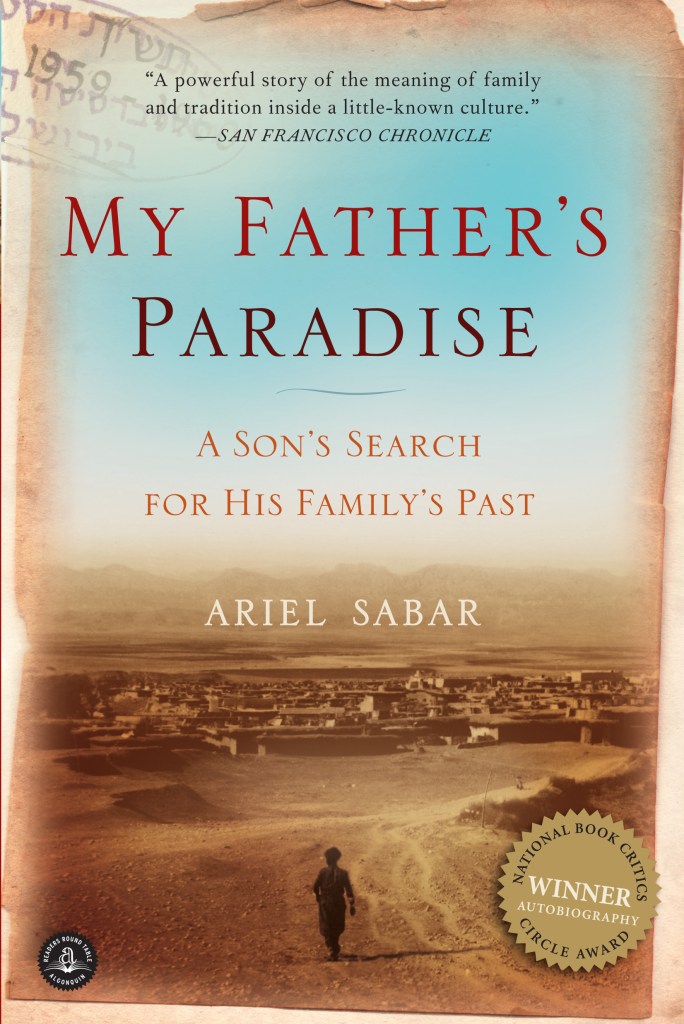
Click here for book club resources for My Father’s Paradise
"Graceful and resonant . . . A personal undertaking for a son who admits he never understood his unassuming, penny-pinching immigrant father, a man who spent three decades obsessively cataloging the words of his moribund mother tongue. Sabar once looked at his father with shame, scornful of the alien who still bore scars on his back from childhood bloodlettings. This book, he writes, is a chance to make amends."
    – New York Times Sunday Book Review

"If Ariel Sabar's My Father's Paradise were only about his father's life, it would be a remarkable enough story about the psychic costs of immigration. But Sabar's family history turns out to be more than the chronicle of one man's efforts to retain something of his homeland in new surroundings. It's also a moving story about the near-death of an ancient language and the tiny flicker of life that remains in it. . . . The chapters describing Yona's budding success as a linguist are thrilling."
    – Washington Post Book World

"A wonderful, enlightening journey, a voyage with the power to move readers deeply even as it stretches across differences of culture, family, and memory."
    – Christian Science Monitor

“A powerful story of the meaning of family and tradition inside a little-known culture.”
     – San Francisco Chronicle

"A biography, a memoir, a meticulously reconstructed history of a largely vanished people and place, and a meditation on one of the world's oldest languages. Transcending mere reportage, it acquires a novel-like warp and weft."
    – Los Angeles Times

A "remarkable new memoir . . . Sabar's Paradise is especially noteworthy because of its multilayered narrative. While it begins with a young man's personal and familial crisis, it ends up exploring universal themes about the linguistic origins of culture and about the vital importance of tradition to the health of any community."
    – Philadelphia Inquirer

"Sabar offers something rare and precious – a tale of hope and continuity that can be passed on for generations. . . . Readers can only be grateful to him for unearthing the history of a family, a people and a very different image of Iraq."
    – Publishers Weekly (Starred Review)

"[Takes] the memoir to a new dimension. . .A book that operates on several levels: as the story of the relationship between father and son, as testimony to a man with a mission, and as a portrait of a nearly forgotten people."
    – National Book Critics Circle Board Member Ellen Heltzel, in public remarks at the New York City ceremony where My Father's Paradise was honored with the 2008 NBCC Award for Autobiography.

"Be forewarned: you will lose sleep over this book. . . . [Sabar] mesmerizes with the very first sentences. . . . In the tradition of the famed storytellers of Zakho, Sabar narrates a saga so touching, so amazing, so miraculous that the reader will feel awe for the resiliency of the human spirit. . . . Unlike many memoirs flooding the book market these days, My Father’s Paradise is both unique and universal.”
    – Roanoke (Va.) Times

"With the novelistic skill of a Levantine storyteller . . . Sabar explores the conflicting demands of love and tradition, the burdens and blessings of an ancient culture encountering the 21st century. A well-researched text falling somewhere between journalism and memoir, sustained by Mesopotamian imagination.”
    – Kirkus Reviews

"A book for readers who hanker after ancient mysteries blended with modern-day suspense: You won't get much closer to a real Indiana Jones tale."
    – Santa Cruz (Calif.) Sentinel

"[Sabar's] a lovely writer, slyly adapting his voice as needed to write about the different generations, shifting from the mode of a storyteller to the mode of a journalist. One of the best recent memoirs I've read."
    – Huffington Post

"Taut and extravagant. A sweeping saga with the cadence of a Biblical tale."
   – Daniel Asa Rose, O. Henry Prize winner and author of Hiding Places: A Father and his Sons Retrace Their Family’s Escape from the Holocaust

"An enchanting combination of history, family and discovery – Ariel Sabar’s chronicle of his journey is flat-out wonderful."
    – Rabbi David Wolpe, author of Why Faith Matters

A "thoughtful, touching book. . . . I could not read quickly enough as the Sabars worked to resurrect the past."
    – Elle magazine, Readers' Prize selection, October 2008

"Excellent. . . . The story is told with novelistic attention to narrative and detail, but its heart is Ariel’s heart, that of a son searching with love for the meaning of his relationship with his father."
    – The Providence (RI) Journal

"Sabar's trip to his father's village yields a fresh perspective on such places as Baghdad and Mosul while introducing readers to a slice of Iraqi culture that has all but vanished."
    – Milwaukee Journal Sentinel

"What makes My Father's Paradise a lovely, meaningful book is that Ariel Sabar's search has unexpected conclusions."
    – The Book Studio (WETA/PBS)

"Written with a reporter's flair for people and places . . . Recommended."
    – Library Journal

"A sensitive exploration . . . [Sabar's grandmother] emerges as a quiet heroine."
    – BookPage

"This touching and brilliantly written book tells an incredible story of a man divided among three cultures. The striking discontinuities in Yona Sabar’s journey reveal the transformations of an immigrant’s life as much as its trials and heartbreak."
    – Sammy Smooha, Ph.D., winner of the 2008 Israel Prize for Sociology and author of Arabs and Jews in Israel

"A lyrical and moving . . . portrait of a lost world. The author renders his father's story with incredible understanding and pathos. It is beautifully written, and readers should run, not walk, to the bookstore to buy it."
    – World Jewish Digest

"An involving memoir that works as both a family saga and an examination of a lost but treasured community."
    – Booklist

"Original and riveting ... A must read."
    – Middle East Policy

"What to read now to better understand Iraq"
    – World Literature Today

No. 1 on list of "The Best Books on the Kurds”
 – as chosen by former U.S. ambassador and Kurdistan expert Peter W. Galbraith for the website Five Books

"Extraordinarily compelling . . . A breakthrough work that provides the reader with a well-researched history of Kurdish Jewry intertwined with an intimate family saga [and] a critical eye towards the erosion of history and the ways in which history shapes who we are as human beings."
    – Sephardic Heritage Update

"Sabar conjures up life in Jewish Kurdistan with the colorful story-telling skills worthy of A Thousand and One Nights. ... This narrative is a significant contribution to the much ignored history of Sephardi and Mizrahi Jews."
    – The Jerusalem Report

"A hot item on the Jewish book talk circuit"
    – Baltimore Jewish Times

"I’m in love with a book about a Bermuda-shorts-and-T-shirt-wearing Jewish boy who grew up in Los Angeles and the odd, frugal scholar from Kurdish Iraq who is his father."
    – Hadassah Magazine

"Fascinating and moving . . . My Father’s Paradise is an important contribution to literature about Jewish history, language, identity, and culture, as well as what it means to be a Jew in the modern world."
    – Jewish Book World

An "outstanding book."
    – The New York Jewish Week & The Los Angeles Jewish Journal


MY FATHER'S PARADISE won the National Book Critics Circle Award for Autobiography, chosen by the national group of 900 active book reviewers as the best autobiography published in the United States in 2008.

It also won the Rodda Book Award, given by the Church and Synagogue Library Association to the adult book published from 2005 to 2008 that best "exhibits excellence in writing and has contributed significantly to congregational libraries through promotion of spiritual growth."

In August 2009, My Father's Paradise was named a finalist for the Dayton Literary Peace Prize, an international award recognizing works of "high literary quality" that help promote peace and global understanding. The book has been translated into Hebrew, Dutch, Turkish, and Chinese.

The book also made The Christian Science Monitor's list of "Best Nonfiction Books of 2008" and its list of "10 Great Books for Father's Day." It was also a Philadelphia Inquirer staff pick and a Publishers Weekly "hot" indie title, and was selected for the September 2008 Indie Next List as a "Great Read" by Indie Bound, the national association of independent booksellers.

Since 2008, the Jewish communities of Baltimore, Denver, Long Island (NY), Northern New Jersey, Philadelphia, Portland (OR), and The Twin Cities (MN) have chosen My Father's Paradise as their "One Book" community read, using the book as a springboard for wide-ranging events and year-long discussions of culture, history and identity. Sabar has been interviewed about the book in the national and international media, and has been invited to speak in cities across the United States, and in London, Istanbul and Montreal.
 Ariel Sabar